
Platforms aren't fixing reach. They're selling it back to you.
Why your views are dropping everywhere, and what the platforms don't want you to know.

hey, I’m Sam. 2x is where I break down what’s happening in marketing and consumer behavior before everyone else catches up.
More from 2x, including new series and exclusive chat feature available for paid subscribers!
In January, Marketing Brew published a piece about marketers turning to content creation after layoffs. Reporter Katie Hicks had one question for me:
“Is content creation a viable career in 2026?”
I wanted to scream “Fuck no it’s not!” relying on these fickle algorithms for your livelihood? That sounds like self-inflicted waterboarding.
But then I had to stop myself. Because I *do* know a handful of creators who do this full time.
So after going back and forth, I told Katie, “The dream is sold to you.” Because it is. No matter if you’re a creator, a marketer with platform contacts, or a founder just getting started.
The social media dream is, to quote the great Cher Horowitz of Clueless, a full on Monet. From far away, it’s intriguing, but up close it’s a big old mess.
As a marketer, brand, creator, independent expert, you can fall for the Monet and idealize what’s possible, OR you can do what I recommend: take a birds’ eye view and observe how “the machine” of social media platforms actually works.
Because the moment you start chasing anything, whether it’s the algorithm, the latest format, or the dopamine hit of one post going viral, you lose. The platforms know that. But you might forget.
Don’t lose to them. You don’t have to let that happen. Instead, let me fill you in on what’s really going on right now.
The surprising predictability of today’s chaos
Imagine spending an hour learning a game like Catan only to be told midway through that the instructions have completely changed.
Welcome to the runaround of modern social media platforms.
You build a strategy around a format, a cadence, or an approach, and then it feels like the very next day it stops working. And you throw your hands in the air, curse Mark Zuckerberg, etc.
To be fair, I remember working in corporate on social media accounts and learning about algorithm changes. But they’d happen maybe two, three times a year. Now? It’s weekly. Daily, even.
As exhausting as it is, if we were to zoom out, we’d see that every major platform has independently arrived at the same algorithmic conclusion in 2026:
Watch time and private sharing now determine your distribution on social media.
And the cherry on top is that your best performing post in the last month might be one that you created off the cuff in 10 minutes (if you create content, you know it’s ALWAYS those posts…)
Psychologists call this illusory control, which is the tendency to believe you have influence over outcomes that are largely random. Platforms maintain this deliberately. The constantly shifting formats, unpredictable distribution, the occasional viral hit that keeps you believing that “OK, this next one is going to be it”…
Does this mechanism sound familiar? If you guessed that it’s the same as a slot machine, you’d be right. You’re not crazy for feeling like you can crack it, because that’s by design.
On top of that:
IG prince Adam Mosseri has confirmed that watch time is the single most important ranking factor for Reels, with DM shares AKA sends per reach carrying the most weight for reaching non-followers
TikTok’s Transparency Center structures its signal tiers with watch behavior at the top as well
And YouTube replaced click thru rate with “viewed vs swiped away” as Shorts’ primary quality indicator
Are these platforms coordinating the same metrics together? Probably not. What’s happening is that they’ve all just arrived at the same logic independently.
Most people today can’t fake watching something for 45 seconds. Think about when you see a friend’s content in your feed - you might “like” it right away, watch for a little, and then move on. The platforms know that. They also know that you wouldn’t DM a friend content you don’t actually care about.
A like on social media in 2026 costs nothing. And it means nothing, too. A thumb tap while scrolling tells the algorithms very little about whether something was genuinely valuable.
And followers follow the same story. Instagram made this shift visible in April 2025 when they officially replaced “impressions” with “views” as the primary metric across all formats. By August it was changing “accounts reached” to “viewers” in analytics. Threads followed.
The platforms really aren't being subtle about which number they want you to optimize for. Follower count is a legacy metric. Views are what the algorithm runs on now.
The platforms have figured out what actually signals quality and have retooled everything around extracting those signals.
The ones I mentioned above are just the start.
Organic reach isn’t declining, it’s actually being killed
Here’s where the bird’s eye view perspective becomes more useful.
Instagram organic reach now averages 3.5% of your followers.
Emplifi’s analysis of 1.9 million brand posts across 9,678 brands found that organic reach fell 30 to 40% across every format in 2025. Metricool’s study of 39.7 million posts found that Reels reach dropped 35%.
On TikTok, something similar has happened: content shares are up 45% year over year, while follower-based distribution becomes less predictable.
Now smart marketers and creators might think that all of this is due to the sheer volume of content being posted on these platforms.
But there’s a twist - while reach dropped 31% on Instagram, views actually GREW roughly 27 to 29%, per SocialInsider’s analysis of 70 million posts.
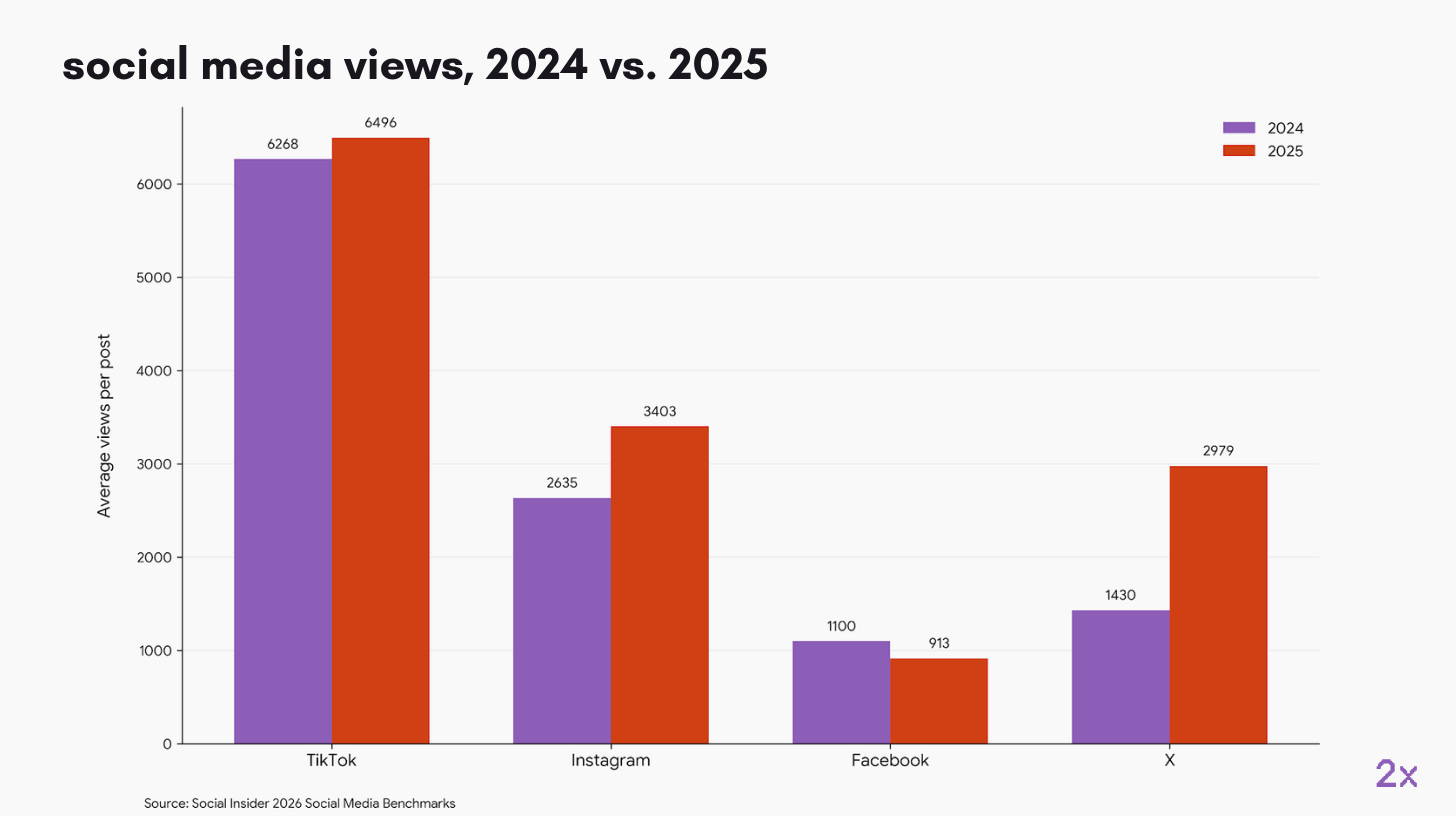
So the algorithms aren’t struggling to manage new content. That’s not it at all, actually.
Instead, they’re CHOOSING to show content repeatedly to fewer people so as to not spread it to more unique viewers. Research almost certainly proves that views going up aren’t new people finding you, they’re the same people seeing you more than once.
Calling it depth over breadth would be far too generous. Because this is exactly what creates what? Oh, yes…. dependency on paid reach!
Organic reach is being compressed because compressed reach is of course, more profitable than open reach. Organic reach is something that can be achieved. Compressed reach, on the other hand, is an intentional, proactive product decision made by these platforms to increase their bottom line.
Months ago, I posted an Instagram story to discourage creators’ excitement about getting more views on Instagram. The platform was purposely increasing views during a time when TikTok was compressing them. I noted how Meta was inciting platform switching behavior, and guess what? It worked. Now, the creators who pivoted to Instagram are asking “Why do I have less views? What happened?!”
Welcome to a concept called loss aversion. Kahneman and Tversky’s research showed that losses hurt roughly twice as much as equivalent gains feel good.
Platforms tease you with open reach first. They let you build audiences, build strategies, and even I don’t know…your livelihood…on top of it, so that compressing hurts much more.
What makes all of this particularly insidious is the fact that engagement hasn’t just evaporated. SocialInsider put it plainly in their report: “The engagement isn’t gone - it’s just moved to the actions that actually drive reach.” i.e. saves, DMs, shares, the measures that the algorithm weighs the highest, but don’t show up in your analytics. How convenient.
When you don’t have visibility and your numbers look flat, you might feel inclined to do something about it. Sometimes, you switch platforms. But other times, you’ll open up your wallet.
Meta’s E2EE move is actually them being honest (for once)
Private sharing is the second half of the map. Per Mosseri’s own confirmed ranking factors, DM shares are the most powerful signal for reaching non-followers.
So watch the sequence of what Meta just did with that information…
December 2025: Meta updates its privacy policy to allow interactions with its Meta AI tools (think chats, voice conversations, questions asked to AI) to be used for targeted advertising across Facebook, Instagram, and WhatsApp. Encrypted DMs between users aren’t covered by this update, because Meta quite literally cannot read them.
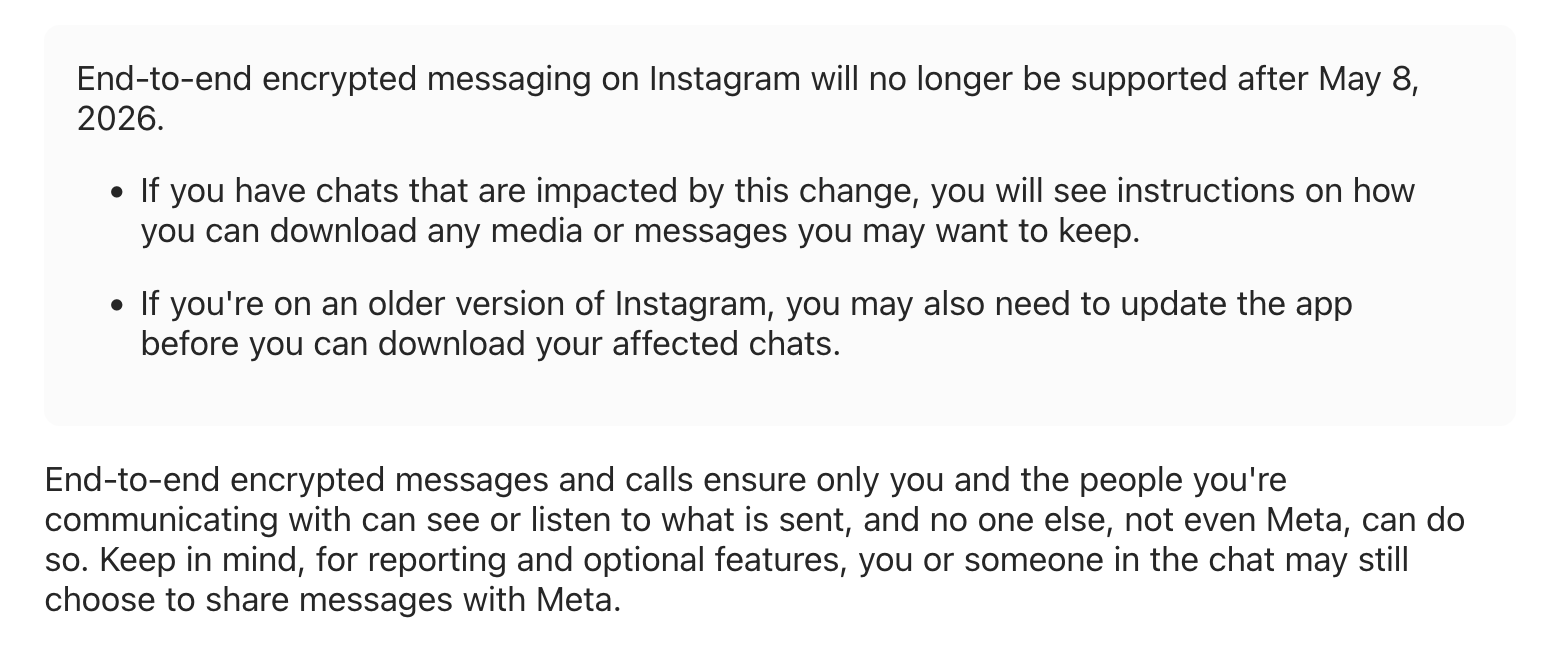
March 2026: Meta announces that end to end encrypted DMs on Instagram will no longer be supported come May 8th. End to end encryption, or E2EE, just means that the sender and recipient can read the messages, but not Meta.
The stated reason why they’re removing it? Low adoption. Right, lol. It’s 100% due to the fact that most people don’t know what the hell E2EE is - and if they did, they almost certainly would want it supported for their “private” conversations.
Private conversations have become the last major frontier of unmined attention on these platforms. Comments are public, likes, even saves are trackable. But DMs are the mysterious black box, and the platforms know that it’s where the most genuine signal lives now.
So Meta made a move to access it and announced it in a little update buried in the Instagram Help Center. Nice.
If you use Instagram, there’s no need to panic or delete the app. I’m telling you, as I have before, that these platforms tell you through their actions exactly what their values are, and where they’re headed. Are you paying attention?
Those who have been following along know that I tracked the migration toward private platforms last summer. This move by Meta was just the next logical step.
@ElizabethEatsNYC won’t be the last
In the Marketing Brew piece I mentioned earlier, Paul Butler talked about going viral with a TikTok post regarding his Amazon layoff.
It opened doors for him AND generated income - and yet he still admitted that he couldn’t replace his Amazon salary from content alone.
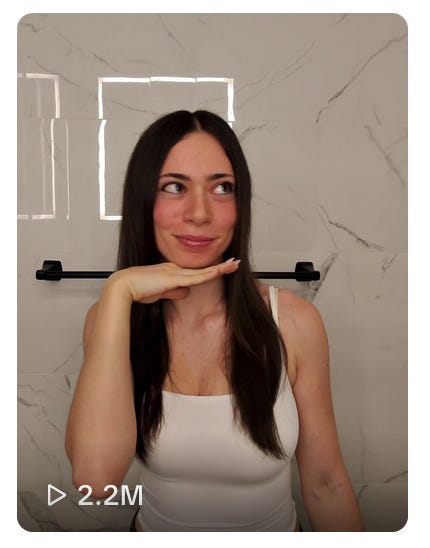
ElizabethEatsNYC is a more recent version of that story. She’s a controversial “foodie” creator with 1.4 million followers on TikTok, known for recording her meals with her Meta glasses.
She posted last week that she’s quitting content creation unless a new path opens up for her because she can’t pay her bills (for reference, she averages about 600K views per video.)
It’s tempting to brush this off as a creator’s poor monetization strategy, but it’s really just the creator economy math running exactly as designed.
The platform captures the attention value the creator generates, monetizes it through advertising, and returns a minuscule fraction (if that) to the person who built the audience and drove the engagement.
Doesn’t this sound a little bit like, I don’t know, free labor from the platforms? Maybe I’m being dramatic. Or maybe soon, we’ll see legislation around this (fingers crossed).
But in the meantime, once you begin to accept that these platforms are indifferent infrastructure and not true partners, it will change the way you use them to make decisions.
The psychological warfare of Instagram Plus
You might’ve also heard that Meta is currently testing a paid subscription tier called Instagram Plus in select markets. The confirmed features are Stories-focused:
anonymous Story viewing
rewatch data
unlimited audience lists
extended Story durations up to 48 hours and
weekly spotlight features
Look closely at those confirmed features…rewatch data, audience segmentation controls, and visibility tools. This is gated data that’s already available for further monetization.
Also notice how you’ll still be targeted with ads. Why would Instagram allow you to pay to remove ads, when you can pay to give them more tracking data?
Instagram Plus, by the way, is also separate from Meta Verified, which targets creators and businesses. They’ve clearly seen success with this program, which allows you to buy a verification badge to prove you’re you - something that should be a fundamental offering of the platform if morality was a factor.
Most modern social media platforms have already built successful businesses on putting ads in front of people. But now, they realize that there could be more ways to monetize beyond ads.
And there’s one platform who seems to have figured it out.
The one place the incentives actually line up
Not every platform has the same incentive structure.
The irony, as I wrote last fall, is that even our instinct to leave these platforms plays out on the platforms themselves - which is exactly why understanding these differences matters more than rage-quitting.
Take Substack, a relative newcomer on the social media scene.
Substack’s head of machine learning, Mike Cohen, said it directly: “The goal of Notes is to get people to discover, subscribe, and ideally pay. That’s how we built the feed and how we continue to iterate to make sure that we’re driving subscriptions up.”
Substack takes a 10% cut of paid subscriptions. No ads. Which means their algorithm is literally incentivized to connect readers to writers they’ll pay for - instead of maximizing scroll time, selling ad inventory, or mining your Chat data. Their business model requires your success in a way that Meta doesn’t.
When a platform’s revenue model aligns with your growth, the algorithm works differently.
Threads seems worth paying attention as well, despite it being under Meta. Buffer’s analysis of 52 million posts found Threads’ median engagement rate at 6.25%, compared to 3.6% on X. The algorithm also seems to reward reply depth over broadcasting, which is genuinely different than other platforms.
The window where this is true won’t stay open indefinitely, as you can imagine. But right now, it’s open.
So what now?
You don’t have to stop using Instagram or TikTok. Reach, however compressed, is still reach, and the switching cost is genuinely high, so I’m not making the argument for leaving, especially when you have a brand to build or grow.
Instead, I want to offer up the argument for making a few specific decisions that the emotional social media fog usually prevents people from seeing:
Lessen your reliability on reach as a primary metric: reach is the metric platforms control most tightly and have the least incentive to give away for free. If you’re measuring success by how many unique accounts saw your post, you’re measuring what they’re actively suppressing. It’s not that reach ISN’T important, but right now based on the latest research presented here, I’d recommend prioritizing tracking your shares and saves “rate” (like an engagement rate) first - as those are signals that platforms weigh the highest, which means they’re also the ones that tell you something true about whether your content is landing
Put real investment into Threads and Substack now: Buffer’s analysis says that engagement is high on Threads. Substack’s algorithm is incentivized to grow your audience because their revenue depends on it. Both of these are early window opportunities
When and if you buy paid reach, buy it with a conversion goal attached, or don’t buy it at all: paying to boost a post because your organic reach dropped is feeding the exact dependency loop the platforms designed. If the paid spend has a specific outcome attached - email captures, product sales, etc. then it’s a tool. But if it’s a reaction to a number going down, it’s a subsidy to the machine that is compressing the number. Please choose wisely
You can imagine how terrifying it must be if your livelihood depends on these platforms, and then you watch your reach drop 35% overnight and you can’t explain why. The fear is so rational and warranted.
But emotional decisions made from whiplash are exactly what the platforms are counting on.
It reminds me of a book I read last month called Thinking in Bets by Annie Duke. She’s a professional poker player and an absolute master of behavioral economics, specifically how we make decisions when emotions are running high and we don’t understand everything.
One of her central points is that it’s ok to say “I’m not sure.”
As professionals we’re conditioned to have answers. But Duke’s argument is that the most sophisticated players are the ones who can hold uncertainty without flinching. They can make the best decision available, still, with incomplete information.
Think of the platforms like your poker competitor. Your competitor is counting on you to make fear-driven reactive decisions, because that behavior keeps you producing content, keeps the feed moving, and keeps the ad inventory full.
Seeing the board clearly is both your strategic advantage, but also your sanity safety net in this hellscape of a performance loop.
You can figure this out. We’ve seen patterns from the past, but we don’t know what tomorrow looks like. And through our actions, we can help shape it.
I don’t know how things will change, but I can say confidently, the days of monopolies having this amount of control are limited.
One thing I can say for certain, though, is that being able to see the board, the players, and your competitors in the view from above is a much better use of your time than stalling and hoping to go back to yesterday.
tldr: in 2026, every major social media platform has independently converged on the same algorithmic logic: watch time and private sharing now determine your distribution, while organic reach is being actively compressed, down 30-40% across formats, in order to drive dependency on paid reach.
Meanwhile, platforms like Meta are dismantling end-to-end encryption on DMs to mine the last frontier of genuine engagement signal. What was once a marketing playbook has turned into a game that’s been redesigned around extracting more value from creators while returning less.
Thanks for spelling it all out.