


Lately I’ve been grabbing a bowl of popcorn and heading to Threads.
There’s something so chaotic about the platform and its users who congregate on Threads specifically to join in on what can only be described as modern water cooler talk.
But recently, I’ve been captivated by a specific, recurring spectacle: tech engineers and frontline employees combating users in replies and posts, covering for their corporate overlords.
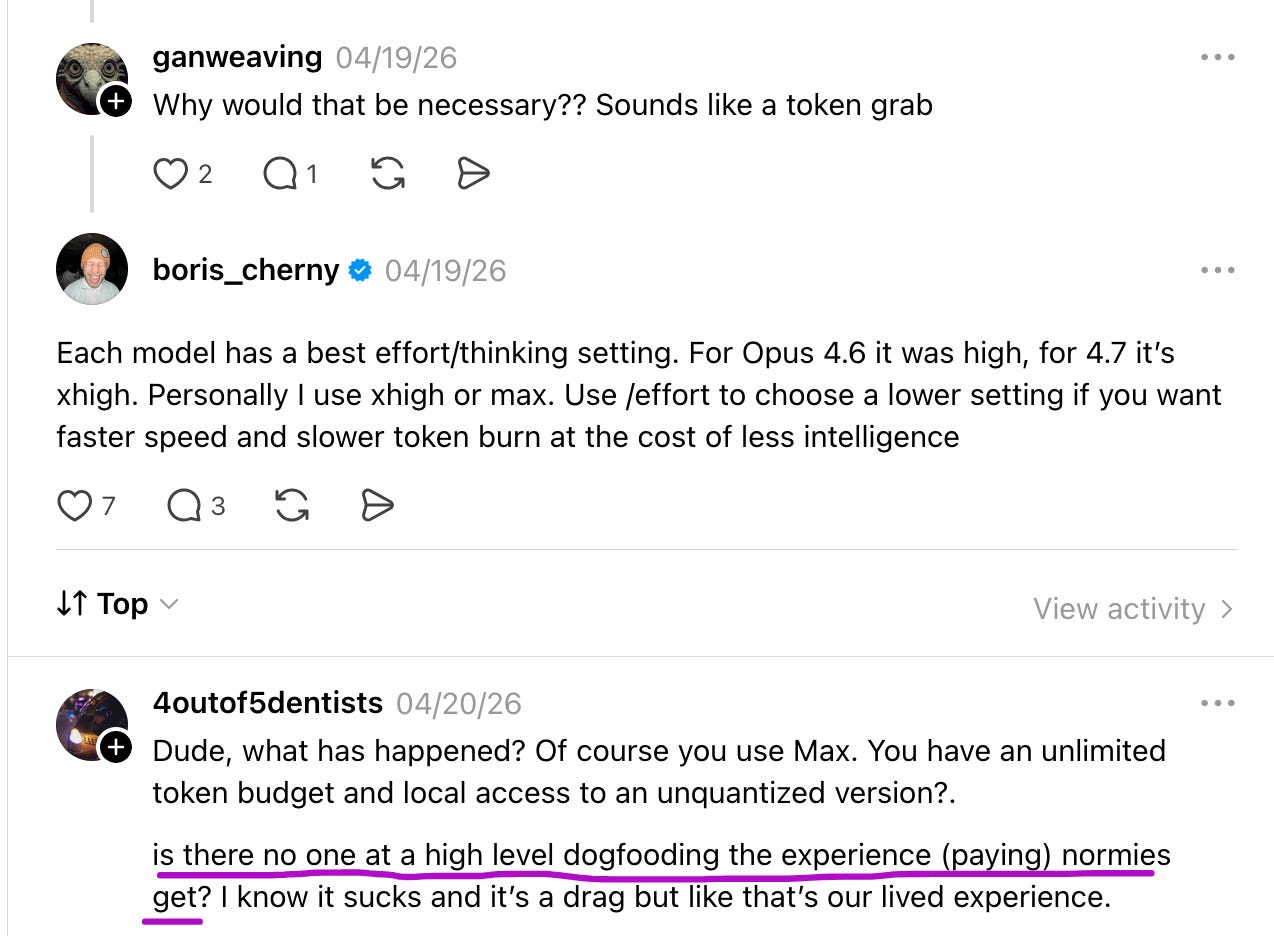
They use their personal accounts to provide real time updates, explain pricing changes, and field what is truly an ENDLESS barrage of complaints.
All under their own names too, and without the protective shield of an official corporate handle.
As a marketer, I’m watching this unfold and thinking, how the hell is this allowed? Are these people freely replying back to people with no oversight?
But then in my bitter marketing mind it makes perfect sense. I’ve started to realize that this is now a deliberate, highly calculated social strategy.
When it comes to dealing with the lowly peasant class of customers/social media users (us!) it’s becoming increasingly obvious that brands are now outsourcing employees and creators as their first line of defense.
A crime of corporate omission
Think about it this way: when a design team pulls together a visual identity, they rely on the branding palette to pull out things like “hero colors” - specific elements chosen to draw your eye and dictate an emotional response.
In modern marketing, human beings are like the hero colors.
Brands intentionally push creators and employees to the absolute forefront because a human face elicits trust, engagement, and warmth (more on the psychology of that in a bit). In an ideal world, a massive corporate entity can fade into the background while customers connect with the person on screen.
But what happens when customers are anything other than satisfied? When they’re pissed off? Fed up?
It’s easy to imagine a boardroom of execs deliberately deploying these people like chess pieces to take the hit. The reality is sadly even more insidious: it’s really a crime of corporate omission.
By failing to step in, brands turn their most visible human assets into their first line of defense.
The playbook in action
To truly understand how pervasive this is, we have to look at how this strategy has played out in Q2 alone.
Case study #1: the influencer (Starbucks & Bran Flakezz)
Look at influencer Brandon Edelman (Bran Flakezz) at Coachella this year, someone who has built a massive platform on sticking up for the underdogs.
And before I get into it, let’s be clear: Brandon is not a helpless victim here. Many have called him out for voluntarily trading his morals for a VIP brand experience at the festival.
But his personal failure is exactly what Starbucks capitalized on.
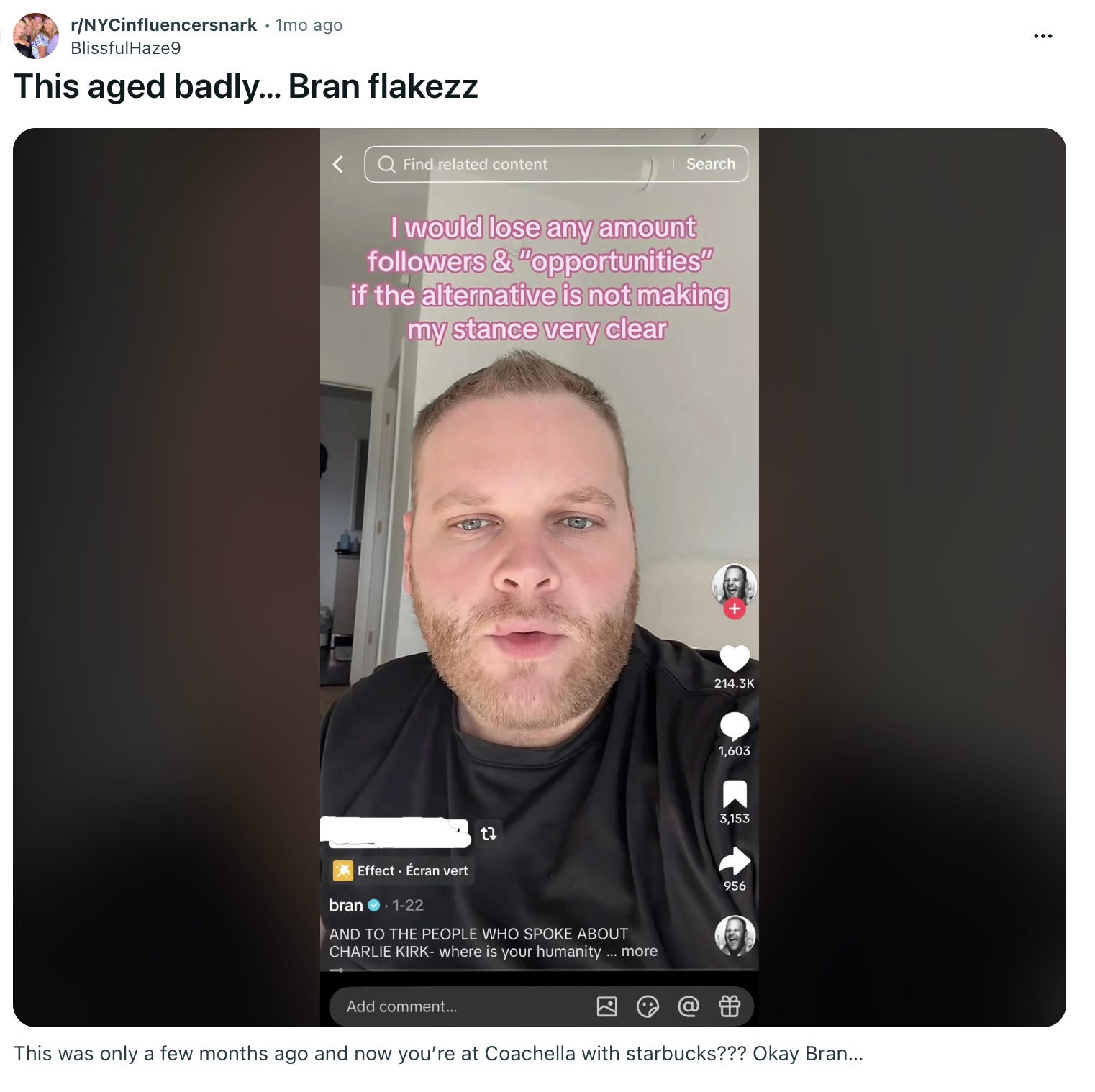
Starbucks didn’t tap Brandon to be a crisis comms rep for their ongoing labor disputes and union busting tactics. They hired him to be one of their hero colors for their Coachella activation.
And when Brandon’s personal hypocrisy collided with Starbucks’ corporate controversies, social media largely bypassed the mega corp and attacked him.
Starbucks stayed quiet and let Brandon’s personal hypocrisy act as a lightning rod so they could safely fade into the background, pulling in an estimated 22 million impressions from the festival’s first weekend without ever having to issue a single public statement.
The creator took the bullet for securing the bag. The brand just secured the bag.
Case study #2: the engineer (Anthropic’s Claude)
The exact same underlying dynamic applies to AI engineers on Threads and X.
Last month, Anthropic quietly updated their pricing page.
Instead of sending out an email or an official post as one would NORMALLY do, they removed access to Claude Code from their $20/month Pro plan.
Naturally, users who had paid for both monthly and annual plans felt duped, and social media again erupted.
But there wasn’t any kind of email or corporate blog post or announcement to absorb the anger.
Instead, engineers and growth leads who had @Claude in their bios, like Amol Avasare, took to their personal social accounts to clear up the madness.
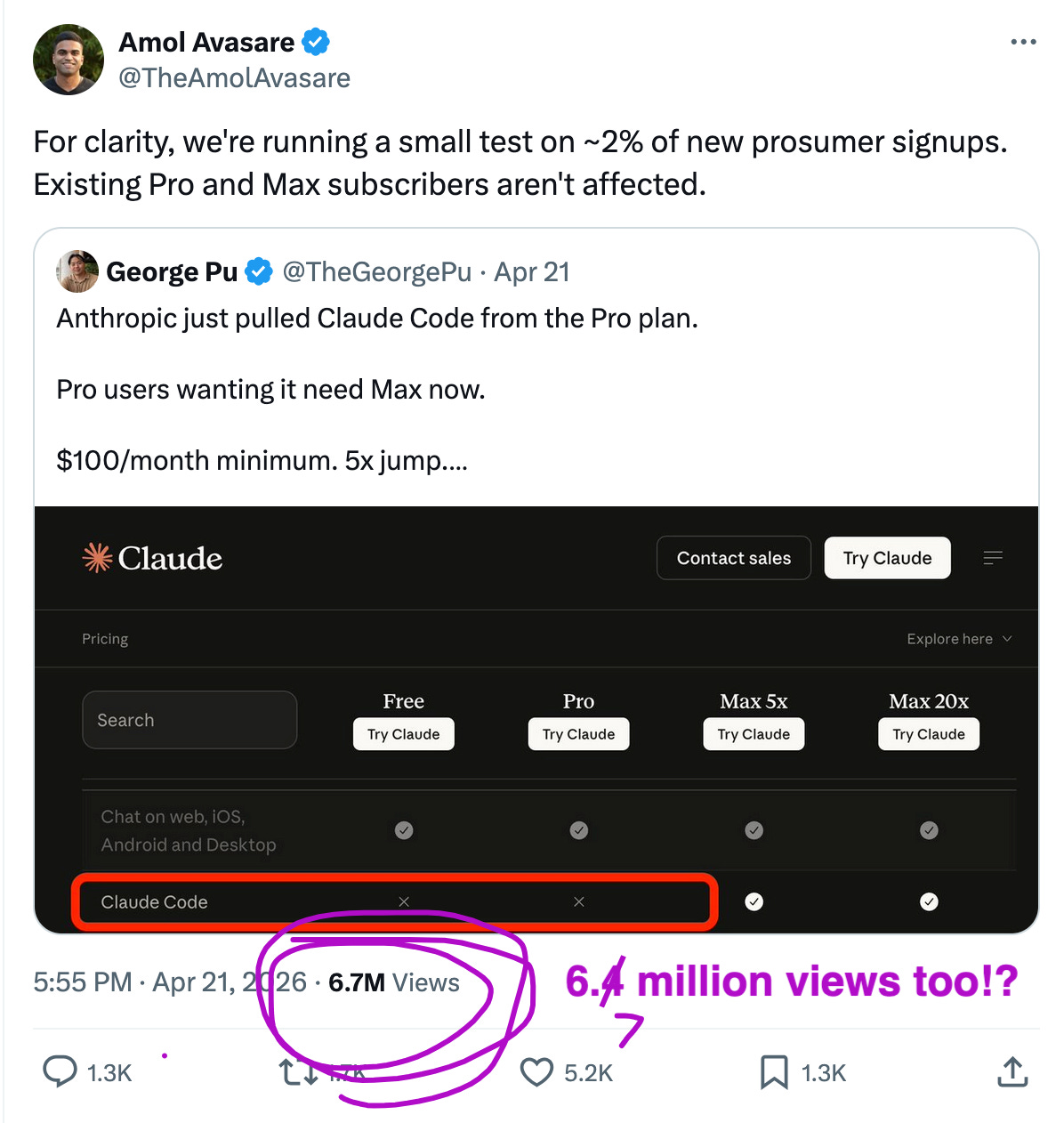
Surely these engineers didn’t wake up intending to act as the global PR department for Anthropic. They were just talking about the product they built.
But the moment users felt slighted by a top-down pricing strategy, they directed their fury at the closest human face they could find.
I can only imagine Anthropic’s leadership telling their team, “You built these tools, you own them, full stop. You’re 100% responsible.”
But that’s a very corporate way of saying “You’re taking the hits for us” especially after the C-suite, not the engineers, speedily pivot pricing to further squeeze subscribers.
Anthropic ended up reverting the changes, but not before conditioning people to bypass the brand account and attack employees directly.
Case study #3: the PR professional (DoorDash & White House)
We also saw the limits of this strategy tested again with DoorDash’s “no tax on tips” stunt in DC.
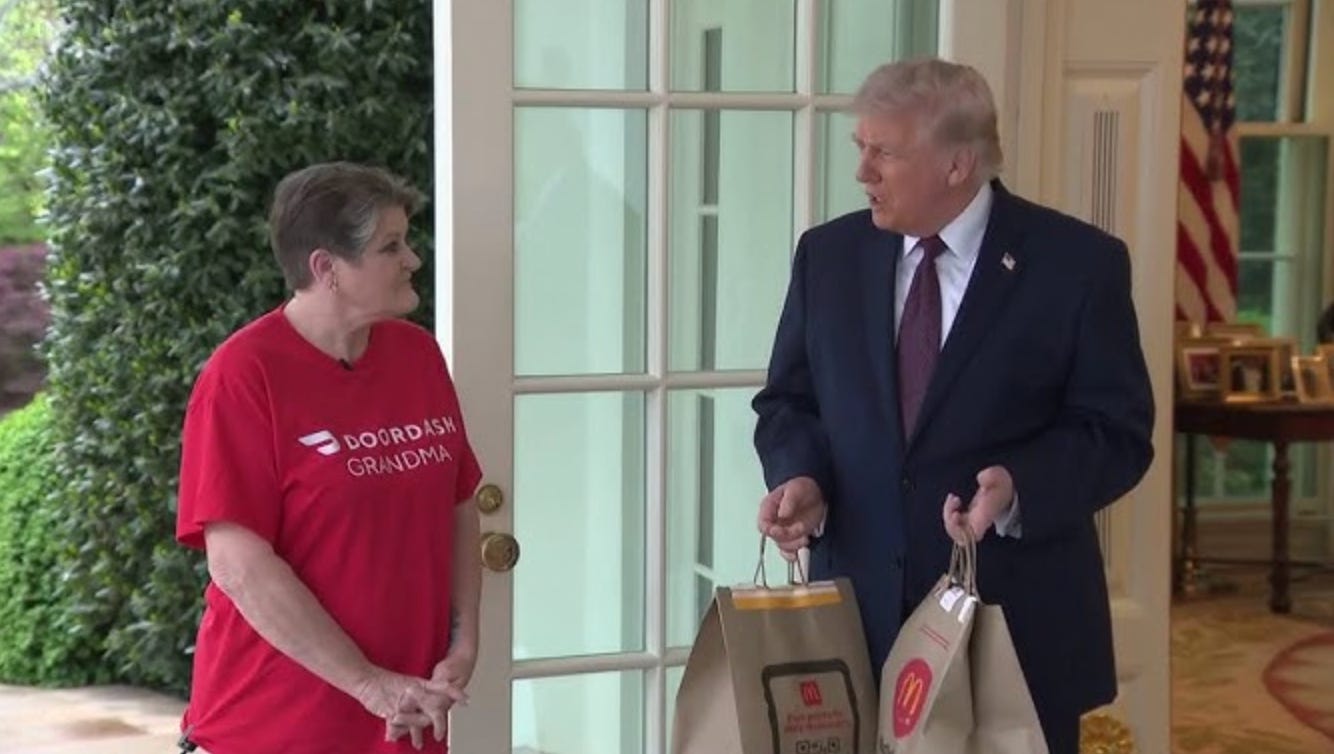
DoorDash arranged for Sharon Simmons, dubbed the “DoorDash Grandma” to deliver McDonald’s to Trump in the White House. But of course, when Internet slueths discovered that Simmons had previously testified before Congress at Republican-backed events, they attacked the whole stunt.
But who took the heat here? Not DoorDash’s CEO. Not the board. The anger was directed at the grandmother herself, sadly, and at Julian Crowley, DoorDash’s Head of Public Affairs, who took to X to personally argue with people, famously telling someone they “needed to touch grass”.
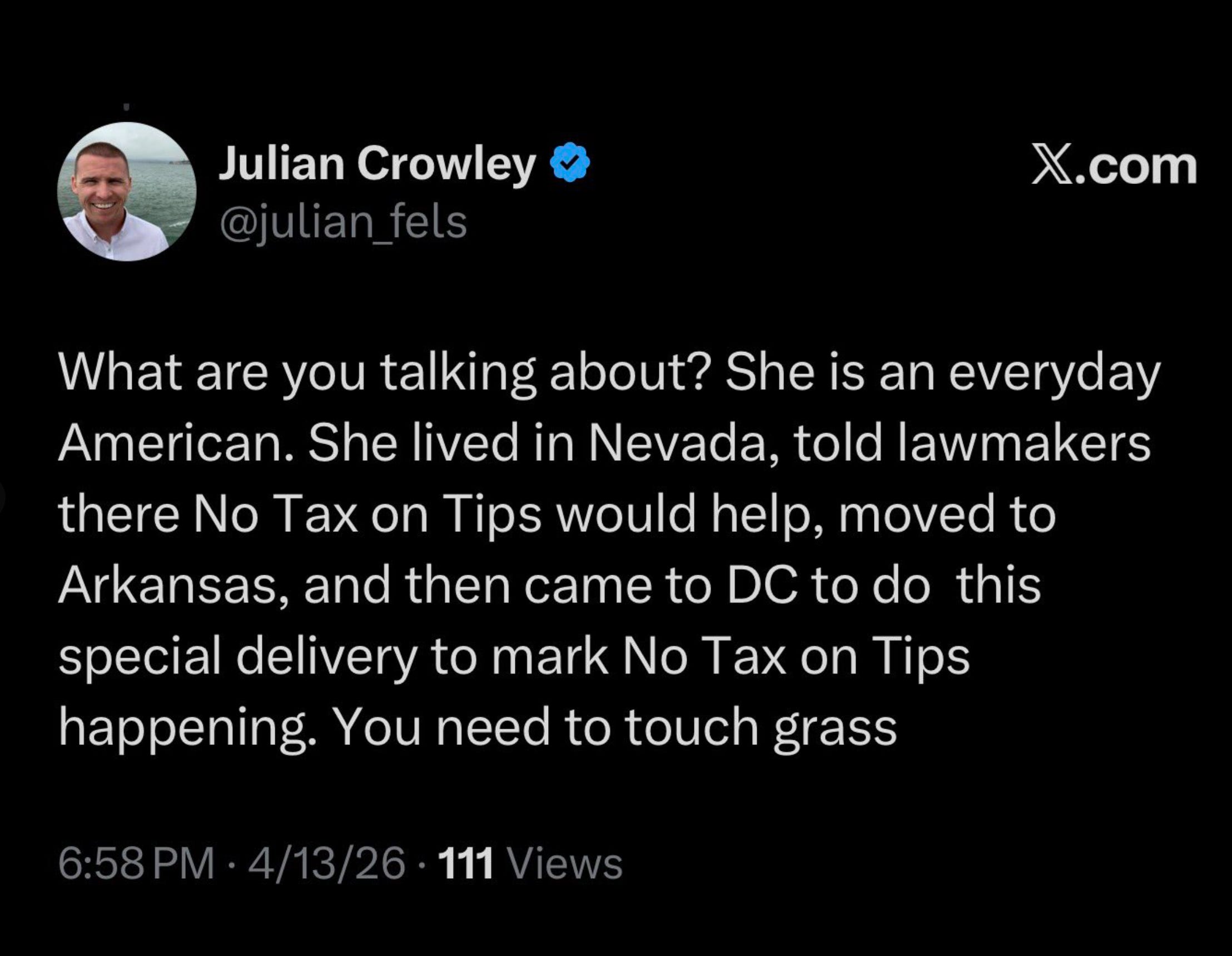
Julian made himself the story in so many ways. This was more self-inflicted than anything, but clearly helped alleviate pressure from the brand account itself, who responded officially, but didn’t receive nearly as much flack.
The takeaway from all of these examples is the same.
Even if you’re trying to be helpful, these employees and creators have become marketing assets left behind enemy lines.
Higher ups at the corporations now make the decisions, and then conveniently take a Hunger Games-esque backseat.
Hacking cognitive load
Big brands, despite their fuck ups, “get” psychology better than most people.
A relatively new study on parasocial relationships shows that our brains process interactions with people on a screen via the exact same neural pathways as IRL social connection. We’re biologically wired to trust consistency (something I’ve talked about before) and we naturally extend grace to faces and names.
But when things go wrong, a darker psychological mechanism takes over - cognitive load.
And that’s because the human brain physically struggles to hold an abstract concept accountable. You can’t yell at a logo (I mean, you can, but you know). You can’t really shame a Delaware C-Corp. Directing anger at a complex, faceless system takes a LOT of cognitive energy.
…but directing anger a single person with a name, a face, and a TikTok account? Too easy. It’s cognitively inexpensive for us humans.
So when a brand stays quiet while an employee or creator takes the heat, they’re triggering the classic scapegoat mechanism.
By providing a tangible human target, the brand vents the public’s rage. The mob gets the catharsis of bullying a real person, and the institutional structures that actually CAUSED the problem get right back to business.
The danger of “building in public”
We also have to look at the internal corporate culture that enables this.
Over the last decade, the tech and startup industry have aggressively championed “building in public”.
Engineers, product managers, and growth leads are highly incentivized to act as micro-influencers for what is essentially their own products. It builds their personal clout, accelerates their careers and can come with major upsides.
But this decentralization of marketing comes with a fatal flaw: brands are turning their employees into spokespeople without any kind of media training.
Call me traditional, but typically, a seasoned PR professional knows how to de-escalate a crisis. They’re trained to stay on message, absorb an insult, and honestly, they know when it’s time to shut up.
But when you put an engineer on the front lines - someone whose literal ego and late nights are IN the product - they don’t always de-escalate. They might take it personally. They could get defensive. They might tell people to “touch grass”.
The brand thinks it’s getting free, authentic marketing. In reality, it’s handing the keys to its corporate reputation over to potentially untrained liabilities.
When you encourage your workforce to build in public, you are inevitably forcing them to bleed in public when things go wrong. All while dangling a carrot that their next promotion or review might be at risk.
The age of the unaccountable
If this strategy of pushing a pawn to the front lines without responsibility sounds familiar, it’s because it’s deeply Trumpian.
Over the last decade, the political landscape has proven that the traditional rules of PR - where an institution apologizes, issues a formal statement, or takes accountability for a misstep - are obsolete.
Politicians have realized that if you simply power thru the outrage, refuse to apologize, and let your minions fight the messy, unfiltered battles in the comments sections, the news cycle will eventually move on. There are very few consequences for shamelessness anymore.
Brands have watched this unfold, and they’ve adapted. They realize that in an environment where unfiltered POVs dominate the algo and traditional accountability is dead, they can take massive risks with near impunity.
The paradox of the “human” brand
Looking even more closely at this dynamic, a terrifying reality is staring us in the face.
For the last however many years, the holy grail of the marketing and advertising industry has been “humanizing the brand”. It’s why every Super Bowl commercial is now anchored with some kind of celebrity or influencer.
We’re been told that people connect with people, not logos.
But the relentless pursuit of making brands “human” is exactly what’s led us to the dehumanization of actual people.
“Humanizing” a brand no longer means acting with empathy, integrity, or accountability. It means finding a human to wear the corporate skin - and potentially shedding that skin the moment the public turns hostile.
We’re watching the ultimate corporate shell game: brands have successfully decentralized the emotional labor, the PR risk, and the mental health toll of a crisis onto their lower level workers, while strictly centralizing the profits and power in the boardroom.
They aren’t just hiding behind humans - they’re using human vulnerability almost as a free insurance policy.
And the worst part of ALL of this is that they do it because we let them.
We’d rather get the quick dopamine hit of bullying a rogue PR guy or a hypocritical influencer than do the exhausting work of holding a faceless institution accountable - or even hold ourselves accountable toward not voting with our wallet for that brand again.
My own marketer confession
Before I give brands and creators advice, I have to point the finger at myself. There’s a very uncomfortable hypocrisy in this entire conversation, and it belongs to the marketing industry.
Quite frankly, we’re the architects of this nightmare, as we are with many things. For years, marketers told brands they needed to “humanize” and show up as real people. We invented the influencer economy to sell more shit. We wrote the playbooks on how to hijack parasocial empathy for profit.
And don’t get me wrong - “humanizing” a brand is still a beautiful, necessary strategy for small teams, founders, and local businesses where humans ARE the company.
But we handed that exact same playbook to multi-billion dollar corps, who took advantage of the human shields.
We’ve built the monster, and now we’re clutching our pearls because the monster is doing exactly what it was designed to do.
Even this essay is part of the cycle. I’m using the chaotic failures of Starbucks and DoorDash to get your attention, riding the algo of outrage to build my own platform. I’m complicit!!!
But just because you and I are in the mud doesn’t mean we can’t change how the game is played. God knows we’re not profiting from our work the way the C-suite or shareholders are.
Now my goal, post corporate marketing, is to bring all of this to the surface.
How not to fuck this up
This new dynamic is teaching creators that having public morals is a liability.
It’s teaching employees that showing outward passion, pride, and protection over one’s work will eventually make them a punching bag.
If we want a healthy space where humans can actually connect, change needs to happen.
For brand leadership
Stop hiding: true trust in a faceless entity comes from top down accountability. If you make an unpopular decision like a price hike, controversial policy, or a layoff - guess what? Your name goes on it and you own it. You don’t let a 24-year-old social media manager or mid-level engineer take the bullet for your boardroom decision
Fund the safety net: if your corporate strategy relies on employees “building in public” you should be legally and morally obligated to protect them when the public turns hostile
For marketers and comms professionals
Stop deploying human shields: influencers and employee advocates are for celebration, education, and community building. No exploitation allowed - and if it feels risky, be a true partner and advocate for the creator or employee and come up with a plan of action together if certain conversations take place
Audit your liabilities: if your strategy relies on building in public, you’re carrying a huge risk. You can’t hand an engineer a mic without giving them media training. If they’re speaking for the product, they’re speaking for the brand
For creators and employees
PROTECT YOURSELF: realize that your personal brand and your mental health are your actual livelihood. To the corporation, you are expendable.
Stop defending institutional failures: if the brand makes a mistake, let the brand issue the statement. if you’re an influencer, vet your brand deals against your stated morals, DUH. Social media will not forgive your hypocrisy and the brand’s definitely not going to save you
The role of marketing has been quietly, non-consensually distributed across the entire digital ecosystem.
Brand accounts might not be dead, but as I’ve mentioned before, they’ve absolutely been reduced to billboards for safe announcements, while the chaotic work of appeasing furious customers is left to individuals.
We need to stop letting corporations hide behind people. The next time you find yourself angry at an employee in the replies, ask yourself:
Who’s sitting safely in a boardroom, on their private jet, on TV making the cool, future-forward announcements…
While also profiting off of their employees, creators…and you?