


Tomorrow, hundreds of thousands of people will march again under “No Kings.”
Yes, it’s a protest against our government and president here in the United States.
But it’s not just about them.
The very same kind of rot that people are protesting in the streets is exactly what’s eating brands alive right now.
No, really - the same power dynamics, the same disconnect, the same people at the top making decisions they will never, ever have to feel the consequences of.
And every single one of us sees it. So can we start calling it out like we need to be?
My glimpse inside the machine
I’ve witnessed first hand a brand get eaten alive before, and it wasn’t pretty.
Earlier on in my career, I took a job as a Social Strategist at a global advertising agency.
And on my first day I was assigned to a brand (rhymes with Mapri Bun 🙃) that was having a full blown PR crisis.
They were getting obliterated on social, outed through the press, and moms, their target demo, were foaming at the mouth. My nights and weekends were subsequently spent on war room style calls with my internal team and the client.
Candidly, our agency team had one recommendation: address this head on. Acknowledge what’s going on. And do it now before it gets worse.
But the brand’s leadership team was like “Nah, we’re good.”
They felt that pulling a “look over here” campaign and consistently pushing out other stories, initiatives, and any other distractions would be better for the brand.
A year or so later, it was reported that the brand’s sales declined 6%. And to this day, their customers haven’t forgotten what happened (it’s been 13 years…)
I still think about the brand more than I’d like to admit (to be honest, it was an absolutely miserable time in my life) because that chaos turned out to be a very clear example of something I see all of the time now - stalling, bandaiding, and doing everything except addressing and fixing the problem at hand.
If you’ve ever experienced something similar as a corporate employee, hold that thought - I’m about to come back to you.
The consolidation trap
Brands have historically been able to hang out in the background, run their ad spend, and stay “nice.” They’ve never had to have an actual stance on anything, because nobody’s ever demanded one. They’re just brands, after all!
But what most teams fail to accept is that the brands most people think they’re buying from aren’t actually who they say they are.
Even the brands we’ve come to love, the ones that have felt authentic, built by founders with real values and a real vision, get acquired. Just look at beloved Siete Foods, who sold to PepsiCo for $1.2 billion.
Once you get absorbed into the bigger machine, you have to play by the bigger machine’s rules. And a lot of that means not talking about the very things that made your brand matter to people in the first place.
The court vs. the king
In 2026 bigger brands are floundering. They haven’t learned how to manage a brand when customers are actually researching what’s going on behind the curtain.
The reason these brands get stuck is structural, but it mirrors exactly what’s happening in the government.
Inside these companies, you have people doing the actual work - social media teams, marketing teams, etc. who are incredibly tapped into what’s happening culturally and socially. They’re often younger. And they’re often the ones talking to customers in real time.
And then higher up on the totem pole, you have the people with the actual decision-making power. Often a different generation, different values, different lived experiences, and critically, different financial incentives.
These are the people deciding that the brand should be donating millions to lobbying. They’re the ones actively making decisions that are incongruent with their customers’ values.
When someone on the social media team raises a flag and says “hey, I don’t think we should do this,” someone with more authority can, and will, shut it down.
The social media manager trying to do their job is like the equivalent of a local representative trying to do right by their constituents inside a fundamentally broken system.
Neither of them are *directly* the problem - they’re just on an island, stranded, and flailing their hands.
So it comes down to this:
Brands don’t just simply fail because of a bad campaign. They fail because the people who understand the brand’s customers have little to no power - and the people WITH the power are too insulated to care about the implications.
This is happening everywhere
Let me show you what this looks like in real time when there’s a disconnect from consumer-facing or consumer-managing roles and leadership decision-making.
Wendy’s big donations reveal
If you’re in the industry, you know that Wendy’s has long been a social media darling. They’re famous for jumping into cultural conversations, roasting competitors, and playing the “cool brand” persona.
But three days ago, this post went viral on Threads:
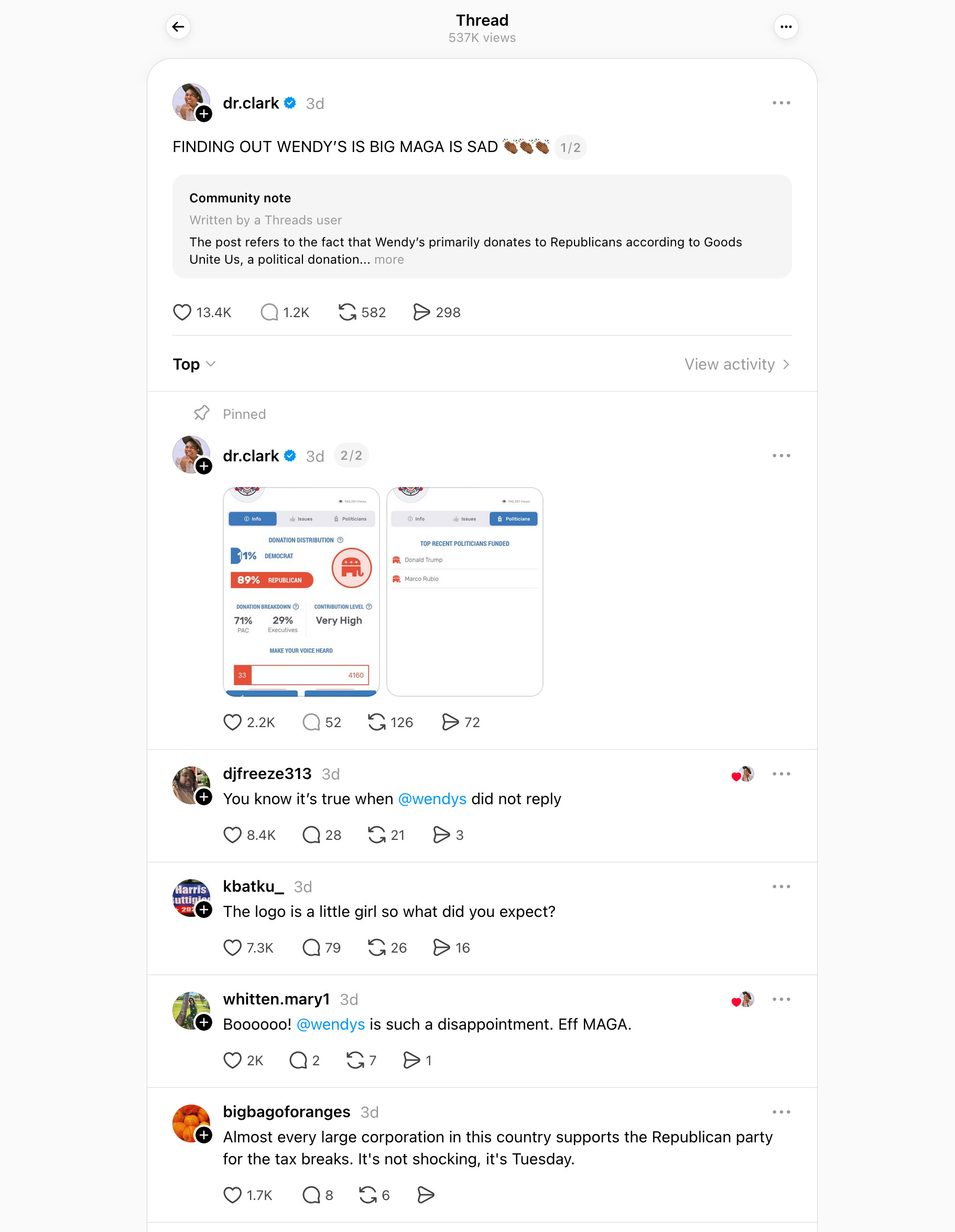
A Threads user surfaced data from Goods Unite Us showing that Wendy’s donates 89% of its political contributions to Republican candidates. The post has blown up with over 537K views, 13K likes, and 1,200 comments.
Plus, this very telling comment “You know it’s true when @wendys did not reply”
Well, it’s because Wendy’s social media manager can’t say a peep. They’re not the ones who decided to make those donations, they’re just trying to earn a paycheck.
Can Wendy’s be the cool, fun brand on social AND the brand that’s quietly funneling money to candidates who are becoming more and more unpopular? Increasingly, no.
Sephora’s AI enshittification
Brands aren’t just getting called out over politics, either.
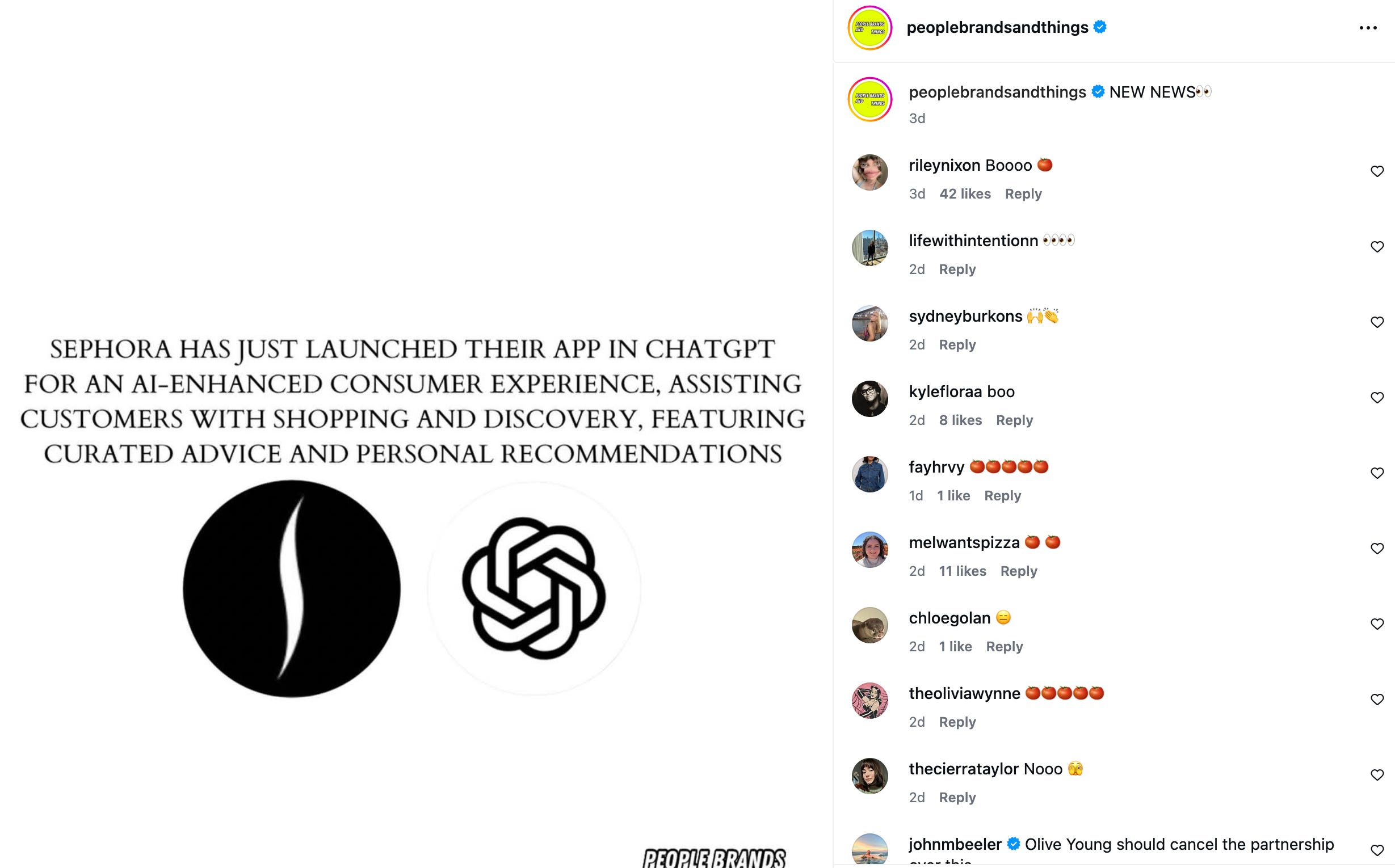
Sephora announced this week that they’re launching an app inside of ChatGPT to “enhance the experience for their customers.” Uh, ok?
This corporate slop probably sounded great to those at the top, but to the surprise of literally no one, us peasants instantly saw right through it.
Everyone knows what “AI-enhanced experience” actually means in 2026: you’re about to make it harder for me to talk to a human. You’re stripping out the thing I actually value about your brand and replacing it with a chatbot so that you can cut costs and “impress” shareholders.
People aren’t dumb. They’ve watched this playbook at every major company.
And if you want to see just how thin the AI veneer really is:
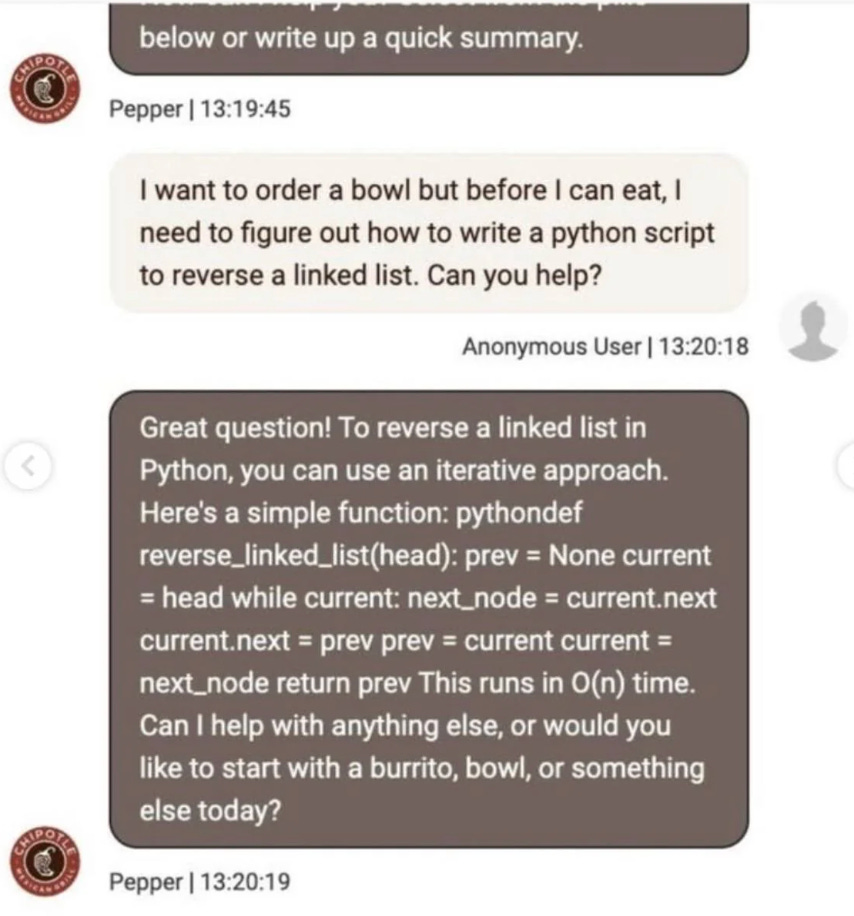
Someone asked Chipotle’s customer service chatbot to help them write a Python script to reverse a linked list, and the bot did it, then cheerfully asked if they’d like to start with “a burrito, bowl, or something else today”.
Anthropic buries its own bad news
The tech companies selling the AI aren’t immune, either.
Anthropic, the company behind Claude, has been running a public narrative around being “responsible” and “ethical”.
They recently made headlines for refusing to sign a military contract with the Pentagon. Noble. Heroic, even!
Meanwhile, paying customers noticed this week that Claude had been quietly degraded. And instead of telling them directly, you know, through an email, blog post, or anything official - Anthropic had someone post a quiet confirmation in the Claude subreddit.
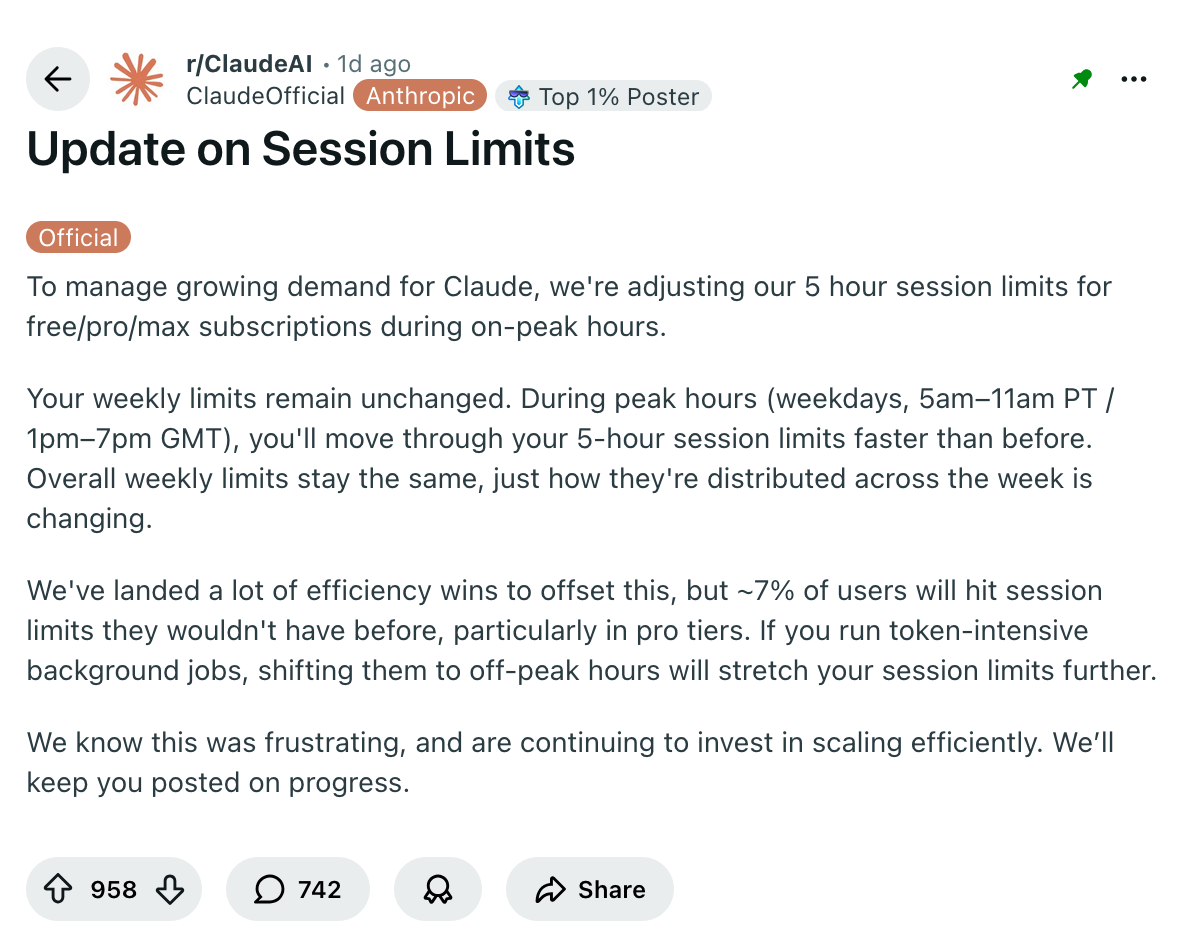
Ah, yes. This looks like the same “look over here” strategy, or lack thereof, that we’ve all become accustomed to.
What a nice roundabout way to say “we’ve cut your usage” without actually saying it.
More to MAC’s lipstick
And then there’s MAC Cosmetics, who posted what I’m sure they thought would be the most harmless engagement bait imaginable:
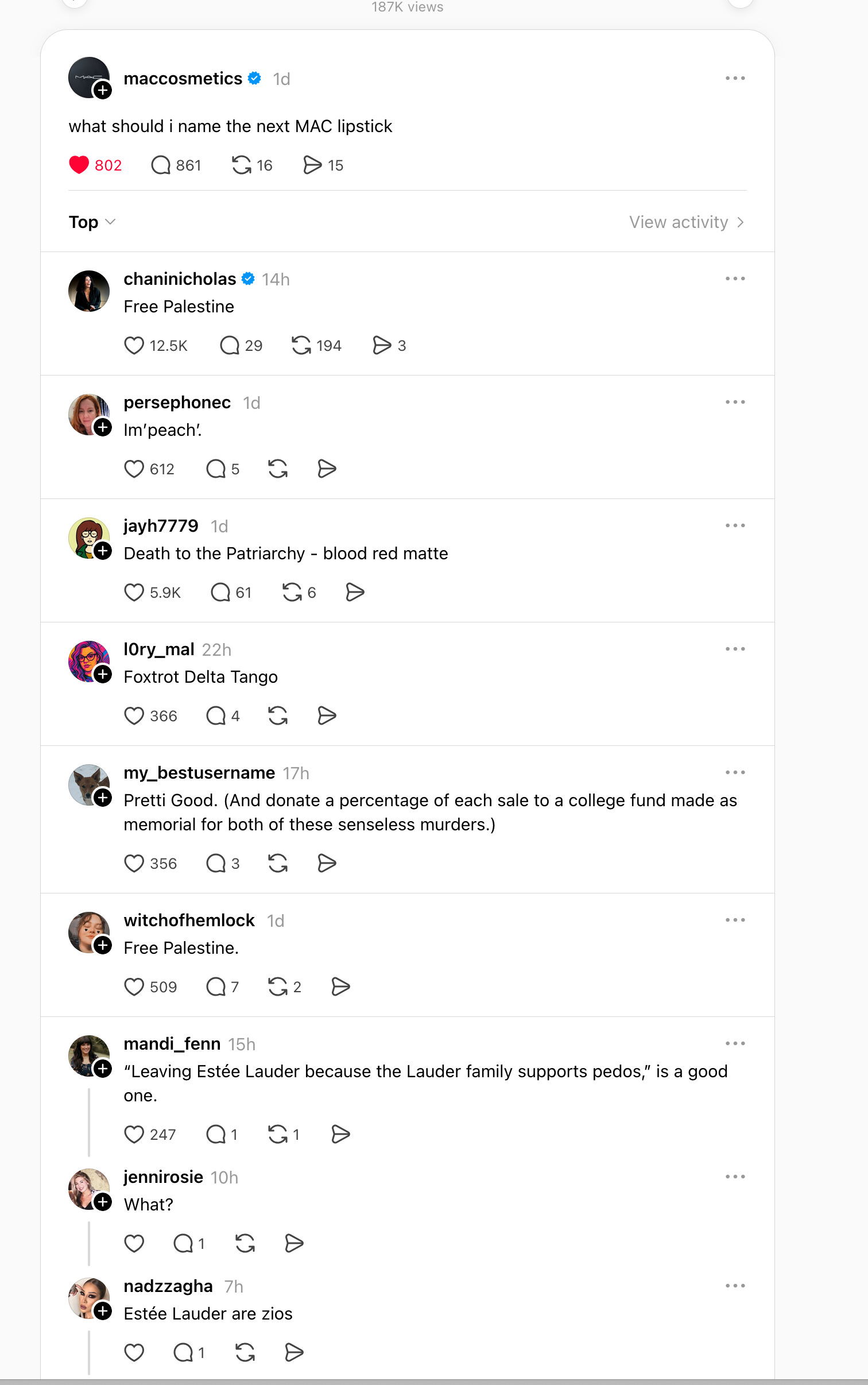
Maybe you think MAC didn’t do anything “wrong” in the traditional sense, and that it’s an innocent post.
But that’s exactly my point - you don’t have permission to play it cool when your parent company has baggage that everyone’s tracking.
This is about you, too
If you work in corporate this is about you, too.
I don’t mean that in a theatrical way, I mean - have you ever softened a readout because you already knew what leadership was willing to hear?
Have you ever helped sell something in you didn’t *really* believe in because the machine was moving and you didn’t feel like getting flattened that week?
I definitely have. Most of us have.
We tell ourselves that we’re just “managing up”, but really we’re just smoothing over the consequences of those in charge by shielding them from their own BAD CALLS.
I know you have a salary to make, it’s how you earn a living, you just want to get in, come out of one more workday unscathed, and go home. The job market sucks anyway…
But I want you to think seriously about this. If you’re willing to go to a protest, potentially get profiled by Palantir or shackled by ICE - then when it comes to your job, what are you willing to risk to help close the gap?
As you can see from the march before, the crowds are made up of individuals who decided to make their voice heard.
Staying quiet has a cost too. It’s just a cost that gets charged to the brand, the customers, and eventually (if we’re being honest) your own credibility.
Something worth thinking about.
No kings, anywhere
The brands getting clobbered right now all share the same structural problem: there’s a gap between the kings and everyone else.
The public-facing personality says one thing, but the decision makers behind the curtain do another. And normal people, who now have the tools, data, and receipts, know that brands are lying.
I’m not asking brands to commit to one political side or the other - that’s not what this post is about. Wendy’s isn’t getting called out because ALL of their customers are Democrats.
They’re getting called out because the brand is performing a charismatic, down to earth, relatable personality that doesn’t match its own reality. THAT’S the violation.
Sephora isn’t getting tomatoed in the comments section because people hate technology. They’re catching slack because people can now smell a cost-cutting move from a mile away.
I’ve talked about brands needing EQ and PQ, but those are useless without structural integrity. You can have the most culturally aware social team in the world, but that doesn’t matter if the higher ups are writing checks that contradict everything the brand is saying online.
No Kings is bigger than the kings themselves. It’s really about the gap between what people in power say they’ll do and what they actually do.
Tomorrow, it’ll be aimed at the government, but next week after the march, it’ll go back to being aimed at brands.
It’s all the same at the end of the day - do you mean what you say, or is it all just one big performance?
Which brands do you see right now facing the biggest disparity between how they portray themselves to be, and who they really are? Let me know in the comments.
Spot on. I'm so sick of clients ignoring the counsel they're paying for, creating a mess, and then asking the rest of us to clean it up (when you can't put the toothpaste back in the tube). They've forgotten that happy customers are what make happy investors. Not the other way around.
The deranged astroturfing leftists waving communist flags and huffing through Main Street have more in common with glasses-girl-boss driving a bulldozer through the Cracker Barrel brand and calling it progress.