


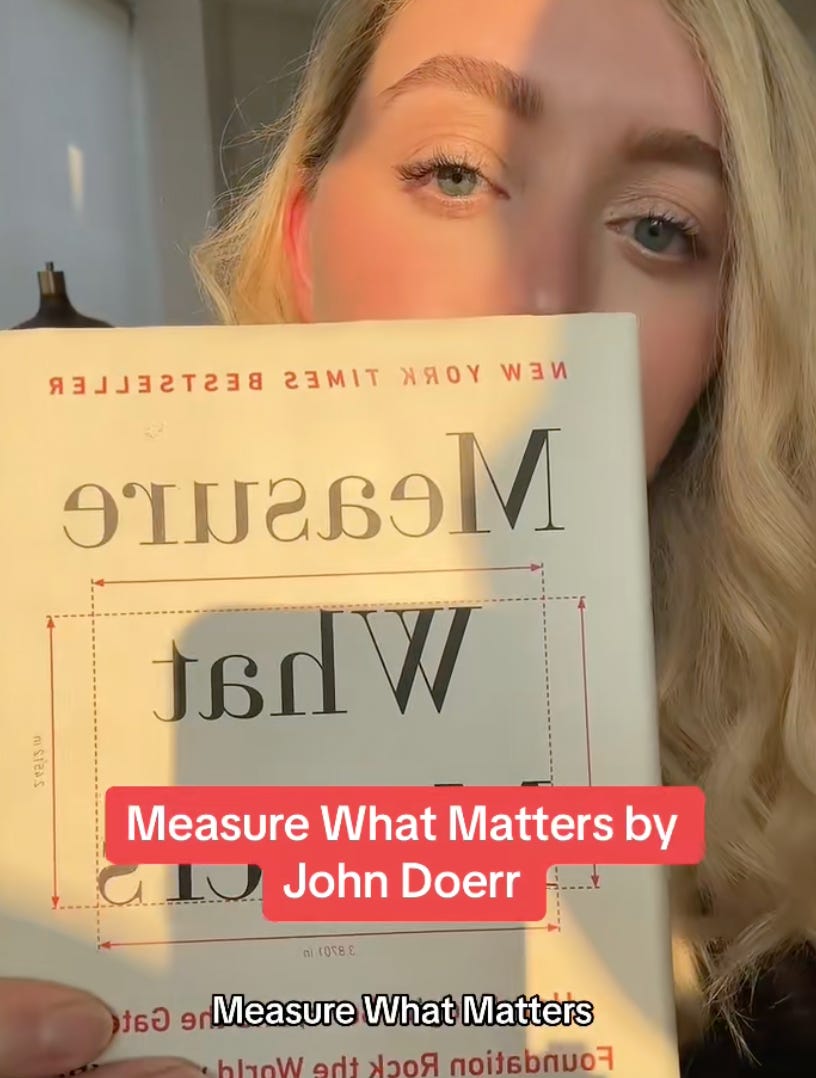
One of my favorite books *used to be* Measure What Matters.
In 2018 I was working inside a global company where no one could agree on the goals. Every team chased something different in their own little silo. And most days I had no fucking idea if I was adding any value.
After finishing the book on a flight home, I was mesmerized by its ability to paint a corporate dream utopia: goals everyone could see, results everyone could measure, and every team pointed in the same direction.
But what really sold me was the idea that I could also make myself measurable.
(Yes, I was in a state of corporate psychosis, I’m still healing from it, etc.)
I could fit into a nicely wrapped little corporate box, pop a bow on it, and bring something to the table that nobody could argue with: numbers.
Here’s my worth, and here’s what I’ve delivered. Add it up!
After this sad-now-but-satisfying-at-the-time business epiphany, I decided to align myself more closely with everything quantitative. Every pitch to finance came back to sales, and if I couldn’t attach a number to an idea, I didn’t bring it up.
And in many ways, I was more “successful”.
At the time, I thought “being strategic” just meant reminding everyone of the hard number we had to hit at the end. Looking back, I think I was sucking the human creativity and care out of every room.
In the moments where I got the this doesn’t feel right feeling, I intentionally pivoted. I self-soothed by acknowledging that the numbers gave me direction and purpose. They were logical and defensible.
Why waste time on anything more abstract?
How the measurable became the priority
In all fairness, the book anticipated this problem.
John Doerr pairs his system of objectives and key results (OKRs) with conversations, feedback and recognition.
But adopting a clear, numeric target is sooo much easier than building a workplace where people can question it.
Numbers give finance something to approve! Leadership gets something to brag about to shareholders. And employees have something to point to when their performance is under a microscope.
But take a concern about customer trust - that usually requires a conversation. Someone has to listen, take it seriously, and have the EQ to read what’s actually going on.
Our current state of sad work culture is the result of what happens when people adapt to what gets rewarded. Ideas with an immediate sales forecast get developed, but ideas that need more time or TLC become harder to justify because, well, profit, duh! Over time, people stop bringing up the things they already know will be dismissed.
This is exactly how a company can say it “values creativity and care” while teaching people to leave both out of the conversation.
And the consequences go far beyond a few boring campaigns.
If a report says something worked, then there’s a definite reason to do it again. The next brief for the next campaign for the next year will ask for more of the same. And the person who raises a concern has to explain why they’re questioning something when the numbers show it’s “performing” otherwise.
So if the numbers go up, do things get better?
You’ve already seen how easily this happens.
A team gets a CTR target, and then after the campaign, they compile a well written PowerPoint headline that selectively surfaces numbers and makes the work look like a job well done.
A customer support team or an AI agent gets measured by how quickly tickets get closed, so rushing someone out of the conversation is painted as being efficient instead of being effective.
Sure, on the surface the numbers would say you’re improving, but are you actually?
Let’s play this out with a real world example from Google.
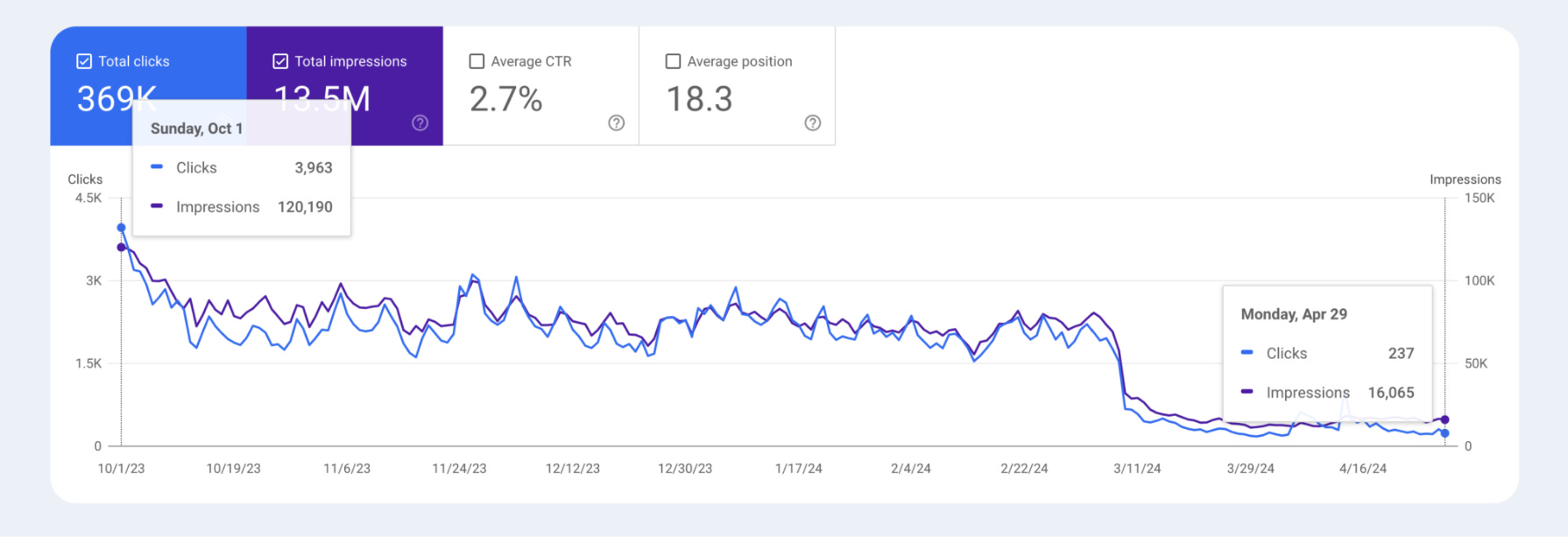
HouseFresh, an independent air purifier review site that actually tests the products it covers, reported a 91% decline in search traffic following Google’s March 2024 core update. Despite the care and time they put toward their content (on top of the traffic they’d already earned), they argued lesser quality content from larger publishers started outranking them in search results.
Of course I don’t know Google’s internal targets, and I can’t tell you which decisions produced those results. But what HouseFresh described should make us question the system that’s in charge of determining what “quality” means.
And as a marketer, I think about the smaller versions of this that happen inside every brand.
A campaign gets attention and headlines, but what are people actually saying? cough cough American Eagle
Customers keep buying, but do they like us, or is leaving just more annoying than staying?
Adobe gives us a pretty tangible example.
In March 2026, Adobe agreed to pay $75 million and provide another $75 million in free services to settle allegations about its shady subscription practices.
The government alleged that Adobe hid important cancellation information and put customers through unnecessary steps, delays, and unsolicited offers when they tried to leave.
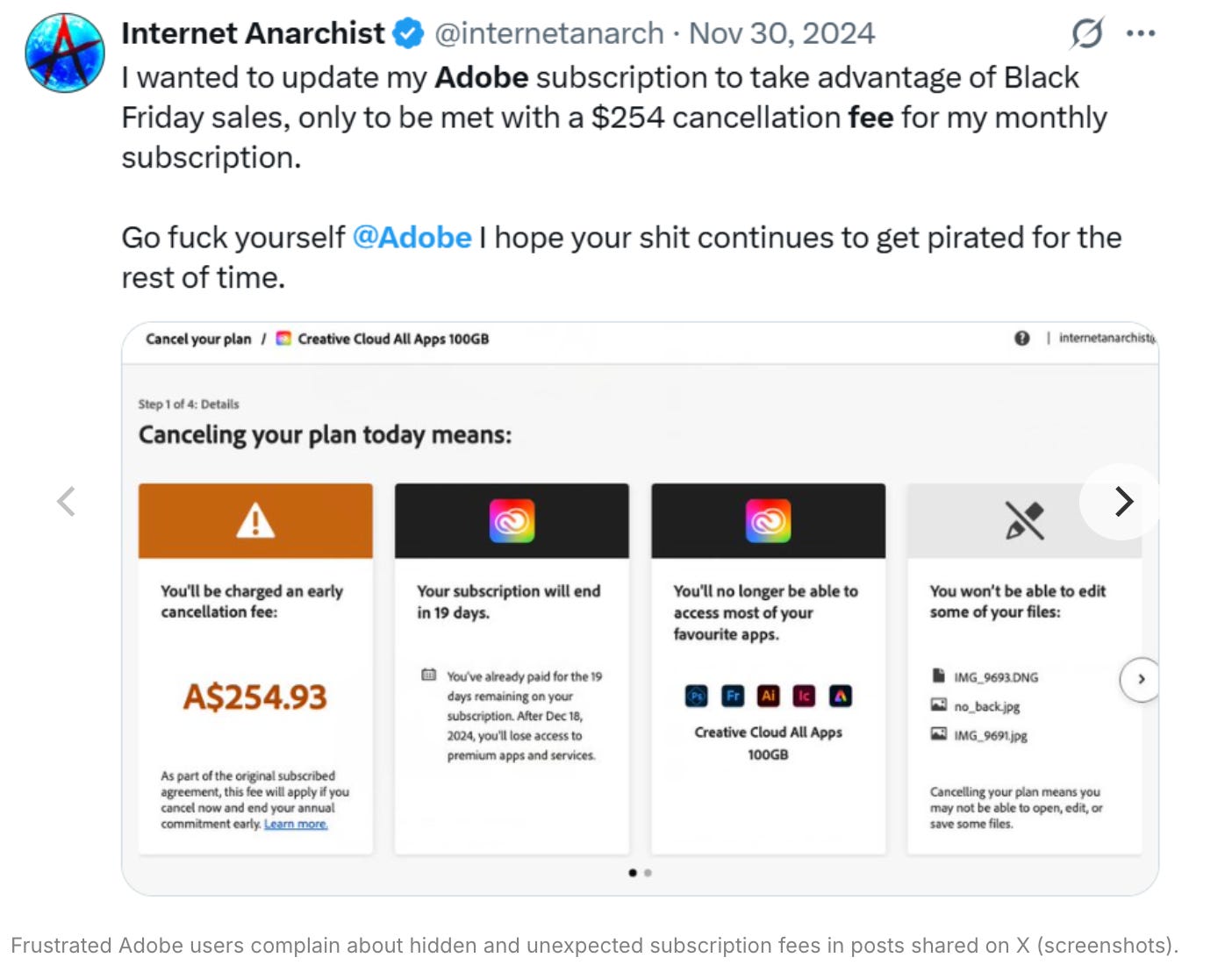
And yet Adobe denied wrongdoing.
So technically, a customer who renews because they love the product - and a customer who keeps paying because canceling is a nightmare - BOTH show up as “retained revenue”.
Those are very, VERY different relationships to build a business around.
I wrote about another version of this in “The race to become ‘one place’”. Sometimes what looks like loyalty is someone being too exhausted to research another option.
So even “good” metrics need questions attached to them.
We can’t assume that a closed conversation means someone feels helped, or didn’t scream at the AI agent. We can’t assume that another automated payment means that someone decided to invest another month. If those distinctions disappear from the report, they disappear from the decisions we make next.
We ignore what we can’t count, and warp what we can.
What would your brand’s dating profile say?
Please don’t get me wrong, measurement matters. But we need to decide what ELSE matters before the numbers dictate everything for us.
I always come back to dating for this (yes, another dating analogy, I’m sorry)…
When you write a dating profile, you’re trying to articulate who you are, what you want, and the type of relationship you’re seeking.
Now imagine writing the whole thing around whichever profiles get the most matches, (which, let’s be fair, people probably do often…)
You might get attention, but would you really be happy to spend every date pretending to like bungee jumping or eating shellfish (which you’re actually surprise! severely allergic to)?
Brands do their own version of this. They look at competitors, trends, and what the shareholders or a dashboard rewarded last quarter, then they build a personality around whatever seems to be working or trending.
Google sees gains from ChatGPT and Claude, and rushes AI into search before it’s ready.
To be clear (again) data DOES matter, and sure, what Redditors write about your industry can also hold weight - but paying attention doesn’t mean compromising your brand every time something pops off.
At some point, you have to know what you’re offering people, who you are, and what you WON’T do to get their attention.
That’s a big part of what I mean when I talk about slow marketing.
Brands have become so good at capturing attention thru cheap tactics like ragebaiting, fake urgency, and ongoing discounting.
But earning attention takes more thought.
What would people actually enjoy from us?
What would help them?
What could we make that they’d remember, share with someone, or come back for without being chased around the internet?
Could we reward our customers in a way that earns their respect and love even if it doesn’t directly contribute to the bottom line?
Let people have an idea first
Now I know that much of this is easier said than done. But here’s how you could start, whether it’s on Slack or in a room IRL.
Picture a brainstorm that opens with “what would people love from us?” instead of “what got clicks last quarter?” or “what does the AI suggest?”
Former colleagues of mine might be shocked to hear me say this, but data can back up an idea without being where the idea starts.
Someone can notice something, have a weird, outlandish thought, and then make a connection that doesn’t immediately come with numbers attached, but theoretically “checks out”. Can you go with it?
If you can, then let’s raise the stakes. Can you also create a space where people feel empowered to disagree?
If someone raises a concern and gets treated like they’re slowing everyone down, their first learned behavior is going to be to stop raising concerns.
But will the problem actually go away, or has the person who notices it just learned to keep quiet?
I want the this doesn’t feel right feeling to start a conversation. What are you noticing? Who might this affect? What would help us understand it?
It’s the EQ side of business that’s constantly left out, but just as vital.
What we can change now
Last November, I ended a post about what marketing had become by asking where we go from here.
And I know now that if we can’t actually fix how we do the work, we’re never going to get anywhere.
I get that a junior marketer can’t decide the company has grown enough, or that someone who’s worried about keeping their job may not feel safe challenging a decision in front of the entire team.
But there may be something IN the day-to-day that you could approach differently.
For example:
Put the customer experience next to the result - if you’re reporting clicks, could you include what happens after people click? If you’re reporting sales, could you add in returns or complaints? Why not bring a support ticket or customer comment into the discussion? This isn’t to stir shit up, it’s to see things from all sides - and you can add that as an FYI in presentations or emails
Turn the gut feeling into a hypothesis - instead of stopping at “this doesn’t feel right,” could you say “I think these constant promotions are teaching customers to wait for discounts. Here’s what we could look at over the next 90 days.” give people something they can expect
Ask how someone could hit the target the wrong way - could we get more sign ups even if the terms are confusing? Could response times look good on paper without actually solving anyone’s problem? What are all of the different ways this could go sideways that might hint at a positive outcome but have issues underneath?
Write down what you won’t do to grow - start with the work you control. Maybe you decide you’re not going to bend the rules on marketing copy to make things sound better than they actually are. If you’re a manager you can bring your team together and agree on what this looks like. Think back on the dating profile: know what you’re not willing to fake
Show people that disagreement can change something - back up someone’s concern with a business example. If feedback changes something, tell people. Create space to play out ideas instead of no space at all
And if you’re a founder or someone who DOES get to choose the direction of a business, I think “enough” deserves a seat at the table.
Enough to pay people fairly, deliver something useful, and keep doing it.
Scale is a choice.
YOU get to decide whether your growth genuinely serves the business and its customers, instead of assuming that bigger will always be better.
A fair trade between a brand and a customer, for something that actually helps them, is success in my book - and that doesn’t become less meaningful because a competitor has “scaled faster”, gotten more funding, or brings more in revenue (despite what news and social media might say).
What I believe now is that brands, customers, and employees can have a relationship where everyone gets something they need. Good ideas must have space to develop.
And personally, I want to do work I can stand behind. That includes the ideas, decisions, and outcomes that may never get noticed or seen. The ones that may never have numbers tied to them.